
BECOME A LEGEND
BECOME A LEGEND
Social Vocial team working on social media management strategy, content creation and community engagement
Social Vocial – Creative Social Media Management for Businesses

What Is Social Media Management? A Business Owner’s Guide to Getting It Right in 2026

What Is Social Media Management? A Business Owner’s Guide to Getting It Right in 2026

What is social media management, and why does it matter for businesses? It goes far beyond publishing posts. It involves understanding your audience, planning useful content, managing customer conversations and learning from the results.

A business can have an impressive Instagram feed and still be doing a poor job on social media. It happens more often than people admit. The photographs look good, the captions are polished, and posts go out three times a week. Then someone asks a simple question about availability and waits four days for an answer. The next campaign starts before anybody has looked at the results of the previous one.

That is the difference between having social accounts and managing them.

For a business, social media isn’t just another place to advertise. It is a public-facing part of the company: part showroom, part help desk, part conversation, and sometimes the first place a potential customer encounters the brand. Running it well means thinking about all of those jobs, not just the next post.

So what is social media management, what does the work actually involve, and how do you know whether it’s worth the time and money? Here is a practical way to look at it.

What Is Social Media Management?

Social media management is the day-to-day and long-term work of looking after a business’s presence on platforms such as Instagram, Facebook, LinkedIn and YouTube. It covers what gets published, how the brand speaks, how customer conversations are handled, and what the business learns from the response.

The short definition usually mentions planning, publishing, engagement and analytics. That’s accurate, but it misses the untidy part of the job. Product details change. Someone sends the wrong image. A customer complains in a comment. A post scheduled for Friday suddenly feels inappropriate because something important has happened. A manager needs to make decisions about those things, too.

Think of a small furniture business. On Monday it might photograph a new dining table. On Tuesday it could explain the difference between two finishes. On Wednesday a customer asks whether the table can be customised. By Friday, the team has noticed that custom sizing is the question people ask most often. That insight becomes the subject of next week’s video. None of these actions stands alone. Together, they form a useful process.

What Does a Social Media Manager Actually Manage?

There isn’t one job description that fits every company. At a small shop, the owner may handle everything. At a larger brand, a strategist, designer, video editor, community manager and analyst may share the work. An agency might coordinate several of those roles.

Still, the responsibilities tend to fall into a few recognisable areas.

Understanding the customer

Before discussing hashtags or posting times, someone needs to understand the people the business wants to reach. What are they trying to buy or solve? What information do they need before contacting the company? Which objections come up in sales conversations? Where do they already spend time online?

A neighbourhood diagnostic centre and a B2B software company may both need social media, but they are unlikely to benefit from the same content plan. One might need clear information about services, preparation instructions and booking procedures. The other may need product demonstrations, industry explanations and evidence that its software addresses a particular operational problem.

A useful starting point is to ask the people who speak to customers every day. Sales staff, reception teams and support employees often know the questions that marketing teams overlook.

Finding a recognisable brand voice

Brand voice isn’t simply deciding to sound ‘professional’ or ‘friendly’. It means knowing how the company should communicate in different situations. Does it use technical language? How much explanation does a customer need? What should a response sound like when someone is upset?

A playful tone might suit a snack brand but feel out of place when a customer is asking a clinic about an appointment. The goal is not to make every business sound alike. It is to make the same business sound recognisable from one interaction to the next.

Creating content worth someone’s time

Content can be a photograph, short video, carousel, customer update, demonstration or a straightforward answer to a common question. Format matters, but the subject matters more.

Consider a home lighting store. It could post a glossy image with ‘Transform your space’ written across it. Or it could show the same lamp in a small bedroom, explain its dimensions and demonstrate the light at night. The second idea gives the viewer information they can use. It may not win a design award, but it does a better job of helping someone decide.

This is why good content planning starts with customer questions and business priorities, not an arbitrary target of thirty posts a month.

Keeping the publishing process under control

Even a small account benefits from a calendar. Not because calendars are exciting, but because forgotten approvals and last-minute requests waste time. A workable plan records the subject, format, person responsible, draft status, approval date and planned publication date.

It should also be flexible. If a product is out of stock, the team shouldn’t publish a scheduled promotion just because the calendar says so. If a local event creates a relevant opportunity, there should be room to respond.

Talking to people, not just broadcasting

Comments and messages often reveal what customers care about more clearly than a polished campaign report. They also require attention. Someone asking for directions shouldn’t have to wait until the next monthly review. A complaint needs a calm, informed response rather than a generic ‘Please DM us’ repeated under every post.

Businesses should agree in advance who answers routine questions, who handles complaints, and when a conversation needs to move to a staff member with more authority. Sensitive information should never be requested publicly in a comment thread.

Learning from the results

Reporting isn’t a competition to find the biggest number on the screen. A post with thousands of views may be useful for awareness. It may be less useful if the business needs enquiries from a specific city and most viewers are elsewhere.

A good manager looks at the numbers alongside the business goal, then makes an actual decision. Perhaps a product demonstration deserves another version. Perhaps a confusing caption needs clearer wording. Perhaps LinkedIn is attracting more relevant conversations than Instagram, even though the audience there is smaller.

Social Media Management vs Social Media Marketing

These terms are related, but they are not interchangeable.

Social media marketing describes how a business uses social platforms to pursue marketing goals. That might involve brand awareness, product launches, paid advertising or lead generation. Social media management is the ongoing work that keeps those plans running: content production, scheduling, moderation, account upkeep and review.

Picture a hotel promoting a festive dining package. Choosing the audience and campaign offer belongs to the wider marketing plan. Preparing posts, publishing the menu video, responding to enquiries and monitoring reactions are management activities. A paid campaign may sit alongside both.

In smaller companies, the same person often handles everything. That’s fine, as long as the responsibilities are understood. Trouble starts when a business buys a ‘social media package’ without knowing whether it includes customer replies, original video production, advertising or reporting.

Why a Business Needs a Social Media Strategy Before a Calendar

Posting frequently is easy to measure. Whether the posts are doing anything useful is harder.

A strategy gives the work a reason to exist. It doesn’t need to be a complicated document. For many businesses, one page answering five questions is enough to get started: Who are we trying to reach? What do we want them to know or do? Which platforms make sense? What can we realistically produce? How will we judge progress?

A new restaurant may want nearby residents to discover its lunch menu. A manufacturer may want procurement teams to understand its capabilities. A salon might want people to see recent work and feel comfortable making an appointment. Those goals suggest very different content.

Start with the business objective, then decide what the audience needs to hear. Reversing that order often leads to a feed full of attractive material with no clear purpose.

Choosing Platforms Without Spreading Yourself Too Thin

The temptation is to be everywhere. In practice, a neglected account can create more confusion than having no account at all.

Instagram is useful for visual stories, product demonstrations, hospitality, lifestyle and many consumer brands. Facebook can be important for local communities, events and customer communication, depending on the audience. LinkedIn is often a more natural place for B2B knowledge, professional services and industry discussion. YouTube can support tutorials, walkthroughs and longer explanations that remain useful over time.

These are tendencies, not rules. A software company might produce excellent Instagram videos; a local retailer might build a loyal audience on YouTube. The decision should come from actual customer behaviour and the resources available.

If the team can only maintain two accounts properly, start with two. Expansion can wait.

How to Build a Content Calendar People Will Actually Use

A content calendar should make work easier, not become another spreadsheet nobody opens.

Begin with a few recurring subjects. A restaurant could cover food, people, events, practical visitor information and occasional customer stories shared with permission. A service business might cover common questions, explanations, behind-the-scenes work, industry changes and service updates.

Then decide which subjects suit a photograph, a short video or a more detailed carousel. Some questions can be answered in fifteen seconds. Others need more space.

Here’s a simple example for a small consumer brand over four weeks:

Week one: introduce a product with a clear demonstration; answer a question customers regularly ask.
Week two: show part of the production or packing process; explain the differences between two options.
Week three: introduce a team member or a genuine behind-the-scenes moment; clarify ordering and delivery details.
Week four: share a timely product update; revisit a question that appeared in comments during the month.

That is eight planned pieces, not a universal posting formula. The right number depends on the business and the quality it can maintain. Stories, quick updates and customer replies may happen between scheduled posts.

A calendar should also show who approves factual claims. Incorrect pricing, unavailable products and misleading promises can do more damage than a missed posting date.

Social Monitoring and Social Listening Are Not the Same Thing

Monitoring means noticing and dealing with individual interactions: a message, a comment, a tag, a review or a mention of the brand.

Listening means looking at the larger picture. Are customers repeatedly asking for the same feature? Is a particular complaint appearing across several conversations? Are people discussing a new concern in the industry?

Suppose a café receives several comments about the lack of non-dairy options. Monitoring involves answering those comments. Listening involves recognising the pattern and passing that information to the people who make menu decisions.

Large organisations may use dedicated software to track conversations across platforms. A smaller business can begin with a weekly review of messages, reviews and relevant public discussions. The tool matters less than the habit of noticing and responding intelligently.

Community Management: The Part Nobody Should Ignore

A brand’s social presence isn’t only what it says. It is also how it behaves when someone speaks back.

A customer asking about a delayed order wants an answer, not a clever caption. Someone making a genuine complaint should be treated respectfully. A person asking about opening hours shouldn’t have to search through six months of posts.

Teams benefit from simple rules. Decide which enquiries can be answered immediately, which need verification and which must go to a manager. Prepare guidance for common situations, but don’t force staff to paste the same scripted response under every comment.

There is a difference between being fast and being helpful. A quick, incorrect answer is not good customer service.

What to Measure: Reach, Engagement, Leads and the Numbers in Between

The right measurement depends on the job social media is supposed to do.

Reach can help assess how widely content is being seen. Engagement may show whether people find a subject interesting enough to react, save or share. Profile visits and website clicks can indicate a step towards learning more. Messages and enquiry forms may be especially important for service businesses.

But no metric explains everything by itself.

Imagine two videos from a local interior design studio. One attracts 30,000 views from a broad audience. Another reaches 2,500 people, several of whom ask about projects in the studio’s service area. If the goal is relevant enquiries, the second result deserves serious attention.

Monthly reporting should answer three plain questions: What happened? Why might it have happened? What are we going to change?

It should also be honest about what can’t be known. Someone may discover a company on Instagram and call two weeks later without clicking a trackable link. Social media can influence a decision without receiving a neat line of credit in an analytics dashboard.

Can Social Media Management Generate Sales?

It can contribute to sales, but it doesn’t operate in isolation.

A good post can create interest. The profile can help establish credibility. A helpful reply can move a customer towards an enquiry. Yet the business still needs a suitable product, competitive offer, working website or booking process and people who follow up.

If visitors arrive from social media and abandon a broken enquiry form, publishing more Reels will not solve the underlying problem.

Businesses should look at the whole journey. Where do interested people go next? Can they find prices or contact details? Is someone answering their questions? Do enquiries become qualified leads or customers?

Those questions matter more than promises of instant growth.

Organic Content and Paid Social Advertising

Organic content is what a business publishes without paying the platform to promote that particular post as an advertisement. Paid social uses an advertising budget to reach selected audiences.

They serve different purposes and can support each other. An advertisement may introduce a brand to someone new. That person may then visit the profile, look through recent posts, read comments and decide whether to enquire.

A neglected profile can undermine an otherwise well-planned campaign. Equally, a useful organic presence doesn’t automatically mean a business can reach every potential customer without advertising.

When comparing management proposals, check whether paid campaign planning and ad spend are included. They often are not, and that distinction should be clear before work begins.

Which Social Media Management Tools Are Worth Paying For?

There is no shortage of software. Some tools schedule posts. Others combine publishing, inbox management, listening, reporting and team approvals. Zoho Social, Sprout Social and Sprinklr are examples of platforms with different approaches and feature sets.

Before buying anything, identify the bottleneck.

If posts keep getting delayed because nobody approves them, a better approval process may be more valuable than advanced analytics. If messages are being missed across several accounts, a shared inbox could help. If a two-person team manages one Instagram profile, native tools and a spreadsheet might be sufficient.

Look for ease of use, supported platforms, reporting capabilities, team permissions and realistic cost. Software should remove unnecessary work. It shouldn’t create an extra layer of administration just to justify the subscription.

Where AI Fits Into Social Media Management

AI can help organise ideas, prepare rough drafts, summarise reports and speed up repetitive tasks. Those uses are practical. They can also tempt teams to produce content faster than they can check it.

A generated caption may invent a product feature. A suggested reply may misunderstand an upset customer. A trendy concept may be completely wrong for a serious professional brand.

Treat AI output as material to review, not as a substitute for someone who knows the business. Facts, claims, pricing, sensitive replies and final creative decisions need human oversight. Automation is most useful when it frees people to do the work that requires judgement.

Social Search: Helping People Find the Right Information

People don’t use social platforms only to scroll. They also search for places, products, demonstrations and answers. A useful video can be overlooked if its title and caption give no clue what it covers.

Use language customers recognise. A restaurant video about a weekday lunch menu should say what the menu is and where the restaurant is located, rather than relying entirely on a vague slogan. A software walkthrough should name the task it demonstrates.

Clear captions, relevant on-screen text and accurate profile information help people understand content. Stuffing unrelated keywords into every post doesn’t make the message more useful.

How Much Does Social Media Management Cost?

The honest answer is that it depends on the work.

Managing one account with a modest number of static posts is not the same job as producing frequent original videos, coordinating on-site shoots, moderating several inboxes and reporting across multiple platforms.

An in-house employee may offer close access to the business. A freelancer may suit a narrow, well-defined scope. An agency can be useful when planning, design, production and reporting need to be coordinated. Each arrangement has trade-offs.

When comparing prices, ask for the deliverables in writing. How many posts and videos are included? Who supplies raw photographs? Are shoots charged separately? How many revisions are covered? Who responds to messages? Is advertising included? What happens if a planned campaign changes at short notice?

A low monthly fee can become expensive if essential work sits outside the package. A higher fee isn’t automatically better either. Judge the scope and the quality of the process.

Common Mistakes That Make Social Media Harder Than It Needs to Be

One mistake is treating the content calendar as the goal. Publishing twelve posts means little if none answers a customer question or supports a business priority.

Another is copying competitors too closely. Their most popular post may have worked because of an audience, timing or brand history you don’t share. Learn from what customers respond to, but don’t build your identity around imitation.

Some businesses change direction after one disappointing Reel. Others refuse to change anything for months. Both extremes are unhelpful. Look for patterns, test sensible ideas and give the team enough time to learn.

Then there’s the overlooked inbox. A company may spend heavily on content while leaving potential customers unanswered. Fixing that basic process may matter more than adding another video format.

Finally, beware of reports that look impressive but lead to no decisions. The purpose of measurement is to improve the next month, not to decorate a presentation.

Should You Hire an Agency or Keep Social Media In-House?

It depends on the business’s capacity and the type of content required.

An owner may be excellent at speaking directly to customers and showing the everyday reality of the business. That closeness can be difficult for an outside team to reproduce. On the other hand, the owner may have no time to plan campaigns, edit videos or review performance.

An agency can provide structure and specialist skills, but it still needs cooperation. Someone inside the business must confirm product details, approve claims and help resolve customer questions. Outsourcing social media does not mean outsourcing responsibility for what the company says.

Ask prospective partners to explain their workflow, not just show a portfolio. How will they learn about your customers? Who writes and checks content? How are urgent changes handled? What does a monthly review look like? The answers reveal more than a promise of viral posts.

A Practical Checklist Before Next Month Starts

Check the basics first. Are profile descriptions, addresses, contact details and links accurate? Is there a clear person responsible for approvals? Do you know which customer questions appeared most often this month? Are there product launches, holidays or service changes the content plan needs to reflect?

Next, look at the work itself. Are the planned topics useful? Does each format suit the platform? Can the team realistically produce everything on the calendar? Is there a way to respond when something unexpected happens?

Finally, look at results. Which content attracted the right audience? Did anyone take a meaningful next step? What did the team learn from comments and enquiries? What should change next month?

If you can answer those questions, you have the beginnings of a functioning social media management process. You don’t need an elaborate dashboard to get started.

Frequently Asked Questions

Is social media management the same as posting on Instagram?

No. Publishing posts is only one responsibility. Management also involves planning, customer communication, monitoring, coordination and reviewing results.

Does every small business need a social media manager?

Not necessarily a dedicated employee. A small business may manage its own accounts effectively if someone has the time, skills and responsibility to do it consistently.

How often should a business post?

There is no number that guarantees success. Start with a schedule the team can maintain, then review whether the content is reaching and helping the intended audience.

Can social media management help with enquiries?

Yes, by helping potential customers discover the business, understand its services and contact the right person. The outcome also depends on the offer, website and follow-up process.

What’s the difference between social monitoring and social listening?

Monitoring deals with individual mentions and conversations. Listening looks for patterns across conversations that may inform content or wider business decisions.

Do social media management packages include ads?

Some do, others don’t. Paid advertising services and the advertising budget should be discussed separately rather than assumed.

What should a monthly report contain?

It should show relevant performance, explain notable changes, connect findings to the original objectives and recommend what to do next.

Are scheduling tools necessary?

Not always. They become more useful as the number of accounts, posts and people involved increases. The process matters more than the software.

How long before social media management produces results?

That varies. A better workflow can improve consistency quickly, while building a relevant audience and generating business outcomes can take sustained work and experimentation.

What should I ask before hiring an agency?

Ask about deliverables, approval procedures, content production, customer responses, reporting, ownership of accounts and what is excluded from the quoted fee.

At Social Vocial, we believe effective social media management starts with understanding your business, your audience, and your goals. As a digital marketing agency, we help brands build a stronger online presence through thoughtful strategies, creative content, and consistent communication.

Final Thoughts

The most useful question a business can ask about social media is not ‘How many posts did we publish?’ It’s ‘Did we help the right people understand us, trust us or take the next step?’

Sometimes the answer will come from a carefully produced video. Sometimes it will come from a plain-language explanation, a timely reply or an improvement to the information on the profile. Those quieter pieces of work rarely attract applause, but they are part of what makes a social presence dependable.

Start with the customer, give the work a clear purpose and build a routine that your team can actually maintain. The content will be better for it, and the business will have a much clearer idea of what its social media is doing.


Branding strategy and creative brand identity development for a restaurant in Delhi
Building a memorable brand starts with the right creative strategy.

How to Choose the Best Branding Agency in Delhi

How to Choose the Best Branding Agency in Delhi

Picture this: you’re getting ready to open a restaurant in Delhi. You’ve got the food squared away, the decor’s shaping up, and you could recite the menu in your sleep. All’s great—until someone asks, “What’s your brand about?” And suddenly, you’re a little stuck for words.

You might know the mood you want people to feel when they enter. But turning that mood into real visuals, messaging, and an experience that sticks? That’s not so easy.

That’s usually when you start Googling “best branding agency in Delhi.”

Here’s the snag, though—every agency calls itself the most creative thing since sliced bread. Their websites look stunning. Their case studies sparkle. But how do you spot the team that really gets what you’re trying to do?

Here are a few things to keep front and center before you sign anything.

Start by Figuring Out What You Need

Not every business needs to start from zero.

Take a brand-new café in Greater Kailash—it needs to build its identity from scratch. But a well-known fashion shop in Karol Bagh? People already know its name. Maybe what it needs is to make sure everything feels connected, whether someone’s at the shop or scrolling Instagram.

Both situations are different, and so are the branding needs.

So, get clear: what’s actually missing?

Maybe people don’t know what makes you special. Maybe your ads look pro, but your social feed feels off. Maybe you’re changing direction, and your old branding doesn’t fit anymore.

Spelling this out, even if it feels messy, makes agency conversations smoother. It also keeps you from wasting money on services you don’t actually need.

Don’t Judge by Instagram Alone

Sure, a beautiful feed looks impressive. But that doesn’t say much about how an agency approaches real projects.

Dig deeper.

If you see branding projects for hotels, ask yourself: do those visuals actually give you a sense of the guest experience? Is the content memorable, or just generic? Does the style stay steady across the campaign?

Try looking at Social Vocial’s work for The Suryaa. It shows hospitality branding that does more than look good on a grid.

When you check portfolios, don’t stop at pretty images. Find out what the client asked for, why the agency made certain choices, and what part of the project they handled.

You don’t need to be a designer to ask great questions.

A Best Branding Agency  Will Ask YOU Questions

Imagine you’re meeting an agency. You say you’re starting a premium skincare line. Ten minutes later, they’re suggesting colors and slogans.

Exciting at first, but, wait—do they know what actually sets you apart? Who you’re selling to? Why someone should pick you instead of another brand?

Good agencies take the time to understand how your business works, who buys from you, who else you’re up against, and where you want to go.

They’ll sometimes question your assumptions, too. That’s a good thing. It’s tough spotting problems when you’re in the thick of it.

You don’t want a “yes” crew who’ll just nod along. You want a team who’ll push you to make better decisions.

Know Who’s Doing the Work

Here’s an easy one to overlook when hiring a branding company in Delhi—the person pitching you might not be the same one working on your project.

You could meet with a creative director, and later end up swapping emails with someone else.

That’s fine, as long as you’re clear about who’s doing what. Ask about who handles the plan, the design, the communication, and the approvals.

Also, check how often you’ll get updates, and who to reach out to if things change.

These details might not sound glamorous, but they’ll save you headaches later.

Branding Services in Delhi: What Does “Branding” Actually Mean?

“Branding” can mean almost anything, from logos and colors to messaging, campaigns, and content.

No one-size-fits-all answer here—just pick what fits you.

Quick cheat sheet:

If you need…Look for support with…
A stronger market spotBrand strategy and positioning
Stickier visuals everywhereBrand identity and guidelines
Distinct way to talk about yourselfBrand voice and messaging
Coherent campaignsCreative direction and campaigns
Consistent presence onlineSocial branding and content

Let’s say you want an amazing look AND campaigns to match—take a look at Social Vocial’s branding services in Delhi.

Remember: always ask about deliverables. Don’t just assume every agency means the same thing when they say “branding.”

What to Ask About Price

Branding projects don’t cost the same for everyone.

A small business just starting out won’t pay what a multi-city company does.

Instead of “How much is this?” ask “What am I actually getting?”

Does the package include research? How many concepts do you get? Are revisions part of the deal? Do you walk away with editable files?

One thing you really want to know—who owns the final work?

A clear proposal should lay out the scope, timeline, payment terms, and exactly what you’ll get. If you’re fuzzy on anything, ask before putting money down.

The Best Branding Agency in Delhi Isn’t Always the Biggest

It’s easy to think bigger means better, but that’s not always true.

Smaller teams can give you more direct attention. Bigger places have specialists and can juggle complex projects.

Both routes work—they just suit different needs.

Opening one restaurant? You’ll probably want personalized help and practical advice.

Running several brands? A bigger team might be a better fit.

Go for the team that fits you. Not just the one with the glossiest client list. That matters more than any claim to be the best branding agency in Delhi.

Already Have a Brand? You Don’t Need to Start Over

Been in business for a while and already recognized? You don’t always need a full rebrand.

Sometimes, you just need clearer messaging, a visual touch-up, or some brand guidelines.

A good agency won’t push you toward a giant overhaul you don’t need. Sometimes tweaking what’s there is smarter than scrapping everything and starting over.

Why Local Know-How Matters

Delhi’s not one market—it’s a bunch of them packed together. The crowd for a South Delhi restaurant isn’t the same as a family shop in West Delhi. B2B companies in NCR? Totally different again.

An agency that understands these differences can give you a big edge. But location shouldn’t be your only filter.

The best partner gets your audience, knows the quirks, and works well with you—even if they’re a cab ride away. That’s worth remembering when comparing a branding agency in Delhi NCR with other options.

Watch How Agencies Communicate

You can tell a lot from your first chats.

Do they really listen? Do they explain things without hiding behind jargon? Are they up-front about what they can and can’t do?

Test them—ask what happens if you’re not happy with the first ideas.

A solid agency will walk you through their process, including how you give feedback and get revisions.

Branding can be subjective, but their choices should make sense when they talk them through.

You should always feel comfortable asking questions—really.

How Social Vocial Handles Branding

Social Vocial combines branding, creative campaigns, social media, and content—one team, all bases covered.

If you want your brand to feel seamless everywhere—from ads to socials to your website—it helps to have the same people running the show.

Example: say a hospitality brand plans a festive campaign. The promo, the photos, the Instagram vibe—it all feels unified, because one team mapped it.

Not everyone needs the whole package. What you need depends on your brand’s stage and where you want to go.

If you’re looking for a new branding partner, have a look at Social Vocial’s services.

Five Questions That Actually Matter

Ditch the endless checklists. Ask these five things instead:

1. What do you need to know about us before you start?

Does the agency do its homework on your business?

2. Can you share a real branding challenge you solved?

Look for their thought process, not just pretty graphics.

3. Who’ll handle our project day to day?

Make sure you know your point person.

4. What’s included in your proposal?

Pin down the details: deliverables, timeline, edits, ownership.

5. What happens after launch?

Is extra support included, or is that a separate cost?

These questions help separate substance from surface.

Wrapping Up

Finding the right branding agency in Delhi isn’t just about picking a flashy website.

Look for a team who digs into your business, asks smart questions, and can explain why they do what they do.

Check the real work, not just the highlights reel. Talk openly about your needs. Set clear expectations.

And remember—big and expensive isn’t always best.

Pick the partner who matches where you are and where you want to go.

Looking for a Best Branding Agency in Delhi?

Ready to launch, refresh, or just pull your whole brand together? Figure out what you need.

Check out Social Vocial’s branding page—see if their style matches what you want.

Frequently Asked Questions

How do I find the best branding agency in Delhi?

Focus on real client work, ask about their process, compare what you actually get, and see who’ll run your project—and how feedback works.

Is a branding agency worth it for small businesses?

Yes, if you need a clearer message or consistent look. Just make sure you only pay for what matters.

What should I have ready before I reach out to a branding agency?

Come prepared with a quick summary of your business, your ideal customers, top competitors, whatever branding you have already, your goals, budget range, and the timeline you’re hoping for.

Can a branding agency help an existing business?

Definitely. They can sharpen your strategy, improve messaging, or help bring everything in line—even if you don’t need a full rebrand.

How long does a branding project take?

It depends. A quick refresh goes faster than a big job that involves research and lots of parts. Be clear about your deadlines up front.

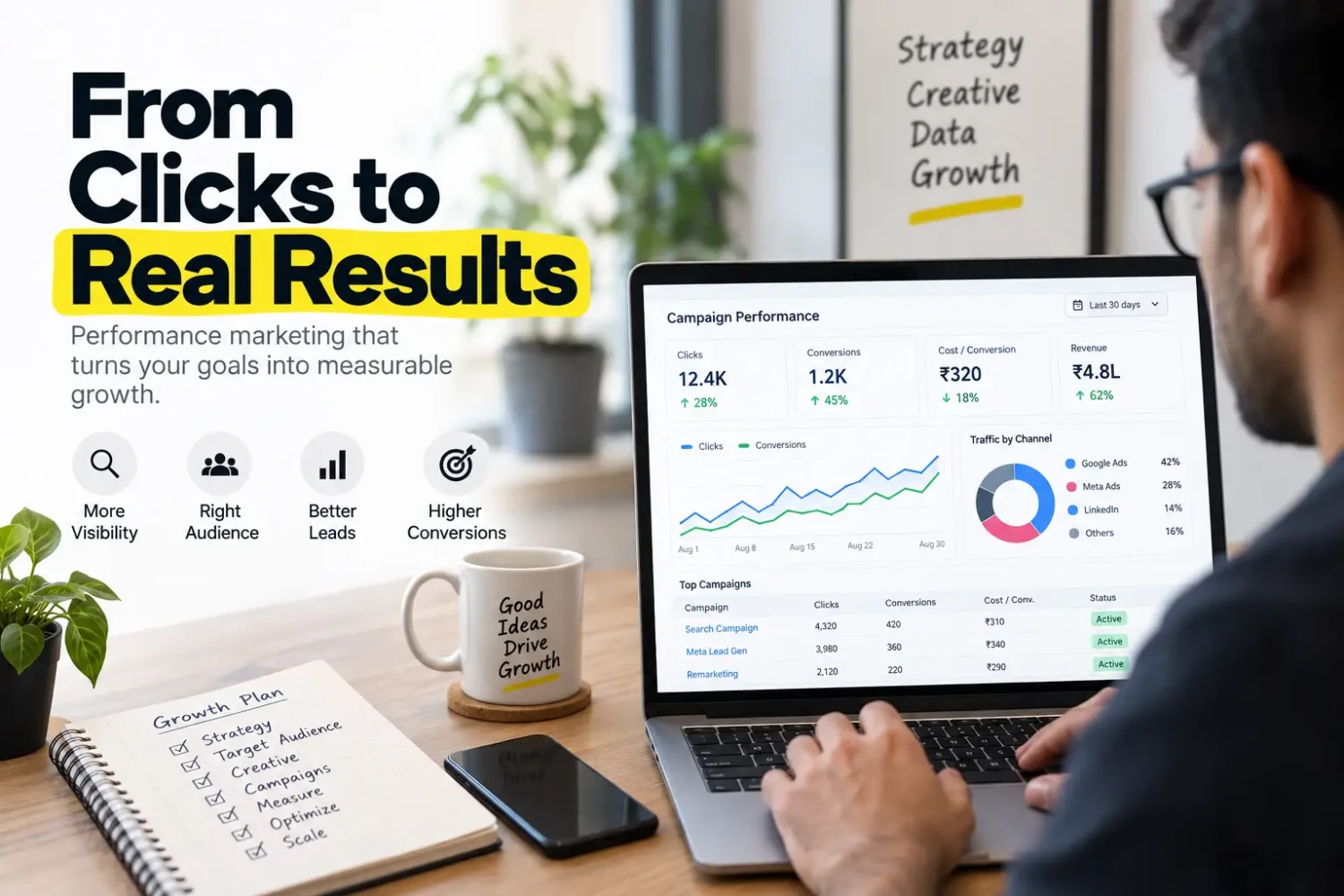
Performance marketing examples showing Instagram, Facebook and social media campaign analytics
Social media performance marketing through Instagram, Facebook and campaign analytics.

Performance Marketing Examples: 5 Social Media Campaign Ideas Explained

Performance Marketing Examples: 5 Social Media Campaign Ideas Explained

Performance marketing examples show how businesses can use Instagram and Facebook to turn social media attention into meaningful actions.

Getting people to notice a business on Instagram isn’t usually the hardest part.

Getting them to actually do something — book a table, send an enquiry, visit a website or place an order — is where things get interesting.

A post can get thousands of views and still bring in almost nothing for the business. Then you can have another ad that doesn’t look particularly exciting, yet it brings in people who are genuinely interested.

So, looking at likes and views alone can be a little misleading.

Before running a social media campaign, I think it’s worth stepping back and answering three simple questions:

Who are we trying to reach?

What do we want them to do?

And once they respond, are we actually ready to handle that response?

Those questions sit behind most of the performance marketing examples we’ll look at below.

These aren’t presented as Social Vocial case studies or promised results. They’re practical examples of how a business might approach different social media campaigns.

1. Instagram Reels for a Restaurant Launch

Let’s say a new restaurant has just opened in a busy part of town.

The interiors are ready. The chef has worked on the menu. The food has been photographed. Everything looks good.

Now the restaurant needs customers.

Reels are an obvious choice because food is naturally visual. But posting a nice-looking plate of food and hoping people walk through the door isn’t much of a strategy.

I’d start by showing people what the restaurant is actually like.

Show the entrance. Show the dining area. Show dishes being prepared. Show a little of the atmosphere. Give someone scrolling through Instagram a reason to think, “I’d like to go there.”

Then I’d start creating content with a more direct purpose.

Maybe there’s a new dish. Perhaps there’s a weekend menu or a special event coming up. Those posts can give people a reason to act now rather than simply watching and moving on.

And there’s one thing that shouldn’t be overlooked: the booking process.

Suppose someone sees the Reel and decides they want to visit. Can they book easily?

A clear reservation link helps. So does a phone number that’s actually visible. Even an Instagram inbox can work, provided someone is there to answer messages.

The restaurant could also put some advertising money behind selected Reels and target people in the local area.

But I wouldn’t get too excited about a Reel simply because it has 50,000 views.

I’d be more interested in what happened after those views.

Did anyone visit the profile? Check the menu? Send a message? Call? Make a reservation?

That’s the information that starts telling you whether the campaign is doing something useful for the restaurant.

2. Meta Ads for a Fashion Brand

Fashion brands have another common problem.

They often spend a lot of time producing one beautiful campaign video and then assume that video should carry the entire campaign.

Maybe it will work. Maybe it won’t.

There’s really no way to know without testing.

A fashion product can be shown in several ways. You can create a polished brand film. You can make a Reel showing different ways to style the outfit. You can zoom in on the fabric, stitching or fit.

They’re all promoting the same collection, but they aren’t giving the viewer the same experience.

That’s why testing different creatives can be useful.

A brand could run several versions through Meta Ads and compare how people respond, while keeping the important campaign conditions consistent.

The results might be surprising.

One video could get loads of likes and comments but barely send anyone to the website.

Another might get much less engagement but bring noticeably more people to the product page.

That doesn’t automatically mean one creative is “better.” It simply tells the brand that people are responding differently to the two presentations.

And then there’s the product page itself.

Someone interested in a particular dress shouldn’t have to land on the homepage and hunt around for it. The ad should take them as close as possible to the product they’re interested in.

For fashion, testing isn’t really about finding the prettiest ad.

It’s about learning which presentation gets the right kind of response.

3. Facebook and Instagram Lead Ads for a Local Salon

Here’s a situation many local salons run into.

They get enquiries.

But enquiries aren’t the same thing as appointments.

Imagine a salon is running an advertisement for a hair treatment. A short video showing the treatment could work well, especially when people can quickly understand what the service is and what they’re being asked to do next.

The campaign can then be shown to people in the local area through Facebook and Instagram.

Before launching it, though, I’d look at something that has nothing to do with the ad itself.

I’d look at what happens when somebody sends a message.

Who replies?

How quickly?

Is there a proper booking system?

Can someone easily find the list of services?

These things matter more than they sometimes get credit for.

For one salon, Instagram messages might be the easiest way to handle enquiries. Another might prefer a booking page. A Meta lead form could make more sense for a business that wants enquiries collected in one place.

The important thing is matching the campaign to the way the business actually operates.

There’s also a difference between getting a cheap lead and getting a useful lead.

A campaign might report a very low cost per enquiry. That sounds good, but what happens after that?

If almost none of those enquiries become appointments, there may be a problem somewhere else.

Perhaps the advertisement isn’t clear enough. Maybe people are asking for services the salon doesn’t offer. Or perhaps genuine enquiries are simply taking too long to get a response.

Increasing the ad budget won’t solve those issues.

4. Retargeting for an Online Skincare Brand

Think about how you normally buy skincare online.

You see something interesting on Instagram.

You click.

Then you start checking the ingredients.

Maybe you read some reviews. Look at the price. Compare it with another product.

And then you leave.

That’s pretty normal.

Not everyone is ready to buy after seeing one advertisement.

Skincare products can involve quite a few questions, which is one reason retargeting can be useful.

With the appropriate consent, tracking setup and audience eligibility, a brand can reconnect with people who have previously interacted with its website.

But showing exactly the same ad over and over isn’t necessarily the answer.

The follow-up content can change depending on what someone might still want to know.

One ad could show the product in use. Another could explain how to use it. Another might take people to a page with more detailed product information.

The website itself needs attention too.

Can someone quickly find the ingredients?

Are shipping costs clear?

Does the checkout work properly on a phone?

These details can easily affect whether a visitor completes a purchase.

Retargeting can bring someone back to the website. It can’t fix a confusing checkout or a poor shopping experience.

When looking at the campaign afterwards, I’d compare advertising spend with actual purchase information rather than relying entirely on the numbers inside the ad platform.

Attribution has limits, and the customer’s full journey doesn’t always fit neatly into a platform report.

5. Creative Testing for a Lifestyle Brand

Some businesses get into the habit of posting every day.

There’s nothing wrong with being consistent, but posting more doesn’t automatically mean the content is getting better.

After a few months, you might end up with a feed full of Reels that are technically different but all feel the same.

Before planning another month’s content, I’d first look at what’s already there.

Which videos are people watching?

What are they commenting on?

Are they saving practical videos?

Are they sharing the entertaining ones?

Sometimes the comments tell you more than the likes.

For example, imagine a lifestyle brand selling everyday accessories.

Instead of creating three completely unrelated videos, the brand could take one product and approach it three different ways.

The first video could simply show how it’s used.

The second could answer a question customers regularly ask.

The third could focus on the product’s design and smaller details.

The brand can see how people respond to each version organically and then decide whether some of the creatives are worth putting behind paid campaigns.

But organic results and paid results shouldn’t be treated as though they’re the same thing.

The goal of the campaign still matters.

For a product-discovery campaign, reach and relevant engagement might be useful signals.

For a sales campaign, website activity, purchases and revenue matter much more.

Posting regularly is one part of social media marketing.

Knowing why you’re posting something — and what happened afterwards — is a much bigger part of it.

Performance Marketing Examples: What Should Brands Measure?

Different businesses will track different things.

A restaurant might care about table reservations. A salon may be looking at booked appointments. An online store may be focused on purchases and the money being generated from its advertising.

Some of the common metrics include:

  • Reach: How many people saw the campaign.
  • CTR: The percentage of impressions that resulted in clicks, based on the relevant click definition.
  • CPL: How much advertising spend was used for each recorded lead.
  • Conversion rate: The percentage of relevant visitors or interactions that completed the action being measured.
  • ROAS: The revenue attributed to advertising compared with the advertising spend.

The important part is not collecting every number you can find.

It’s knowing which numbers actually answer the question you’re trying to solve.

For example, a restaurant running a campaign to introduce itself locally may not get much useful information from ROAS.

There’s another complication too: attribution isn’t perfect.

Someone may discover a business on Instagram, think about it for a few days and then call the business directly. That later phone call might not be connected to the original social media interaction in the platform’s reporting.

Privacy settings and attribution rules can affect the numbers as well.

That’s why campaign reports are more useful when they’re compared with the business’s own records.

The Role of Creative in Social Media Campaigns

Good targeting can help put an advertisement in front of the right audience.

But once the advertisement appears on someone’s screen, the creative has to do its job.

For a restaurant, that might mean making the food look appealing and giving people a feel for the atmosphere.

For a fashion brand, it could mean showing how a product looks when worn rather than only showing it on a plain background.

For a salon, it may simply mean explaining the service clearly enough that someone understands what they’re enquiring about.

These aren’t small details.

People aren’t opening Instagram because they want to sit through advertisements. They’re there to watch videos, discover things, follow people and find content they care about.

A campaign has to fit into that environment.

It still needs a business objective, but it shouldn’t feel completely disconnected from the way people actually use the platform.

At Social Vocial, social media strategy, creative direction and campaign planning come together as part of the process. The starting point is understanding the brand, the audience and the message that needs to reach them.

Explore our social media marketing services to learn more.

Final Thoughts About Performance Marketing Examples

There isn’t one social media formula that every business can copy.

A restaurant may need Reels that make the place feel worth visiting. A fashion brand might need to test several ways of presenting the same collection. A salon may discover that its biggest issue isn’t advertising at all, but what happens after someone sends an enquiry.

That’s why the business objective should come first.

Know who you’re speaking to. Give them a clear next step. Make sure the business can handle the response.

Then look at what actually happened.

That last part matters.

The next campaign should learn something from the previous one. Maybe a certain type of content attracted more relevant visitors. Maybe an ad generated enquiries but very few bookings. Maybe the website caused people to drop off before purchasing.

Those findings give you somewhere to go next.

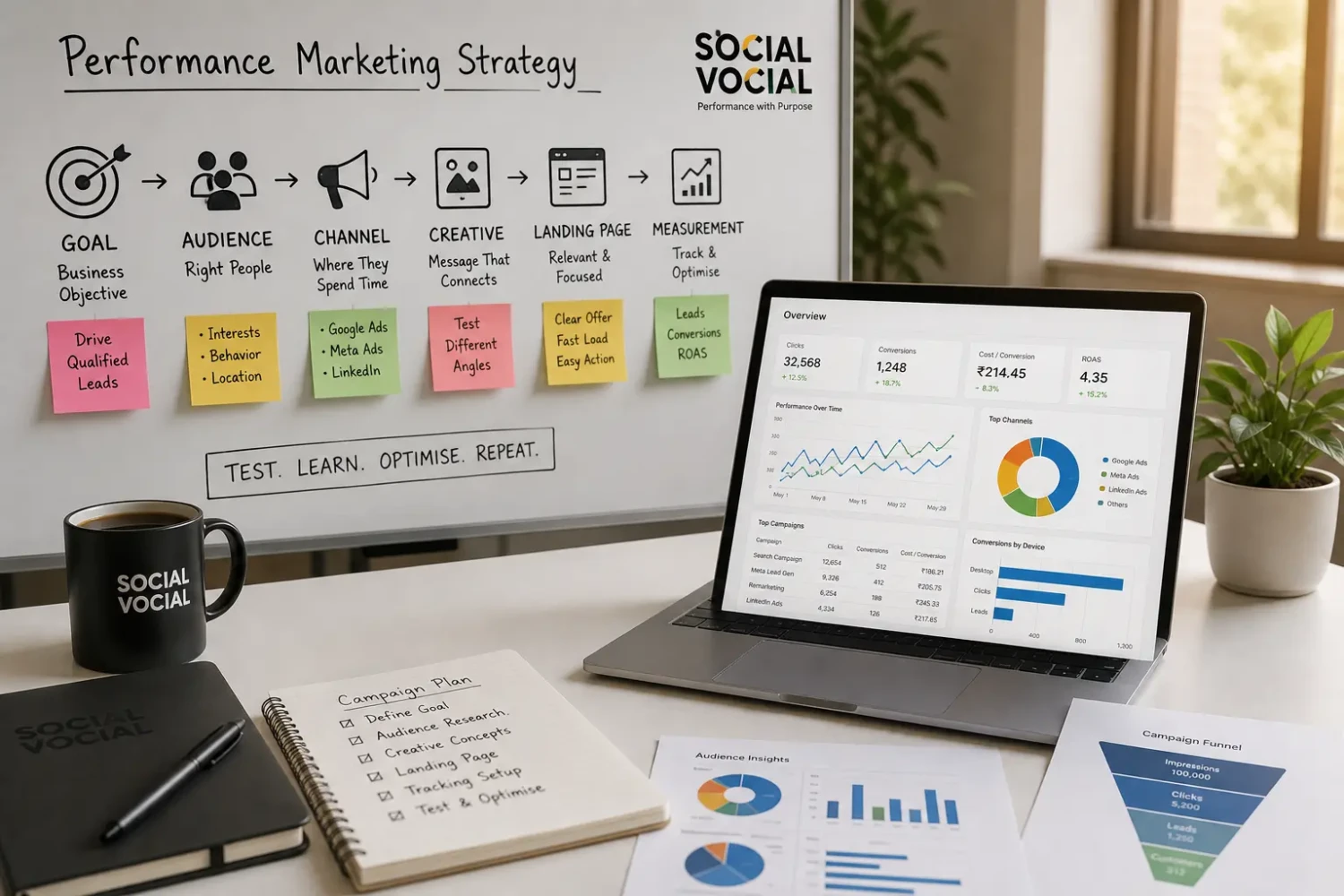
Performance marketing strategy planning and campaign analytics

How to Build a Performance Marketing Strategy That Drives Results

How to Build a Performance Marketing Strategy That Drives Results

Running ads is easy. Building a campaign that tells you what to do next is harder. A business can have the right platform, a decent budget and plenty of clicks, yet still struggle to explain whether its advertising is actually working. Usually, the problem starts before the campaign goes live. A useful performance marketing strategy connects the business goal with the audience, message, creative, landing page and measurement. It gives every part of the campaign a reason to exist. Here’s how that looks in practice.

Start With the Business Goal, Not the Ad Platform

“We should run Meta Ads” isn’t really a strategy.

Neither is “let’s spend ₹50,000 on Google this month.”

Before deciding where the ads will run, decide what the business actually wants from them.

A service company may need qualified enquiries. An ecommerce brand might be focused on purchases. A restaurant may want reservations, while another business could be promoting registrations for an upcoming event.

That goal affects almost everything that follows – from the campaign format to the metrics you eventually care about.

If the objective isn’t clear at the beginning, it’s surprisingly easy to optimise a campaign for numbers that don’t mean much to the business.

Be Clear About Who You Want to Reach

More people isn’t always the answer.

Suppose a campaign reaches 200,000 people but most of them have little interest in the offer. The reach looks impressive in a report, but it hasn’t necessarily created anything useful.

A better starting point is understanding who is most likely to need the product or service.

That might involve search intent, customer interests, location, previous website activity or what the business already knows about its customers.

You don’t need to know everything about an audience before starting. Campaigns themselves can teach you something.

The important part is beginning with a sensible assumption and then checking whether the results support it.

Match the Channel to the Customer’s Situation

Google Ads and Instagram Ads can both generate business, but people use those platforms differently.

Someone searching Google for “office interior designer” is already expressing a need.

The same person scrolling Instagram probably isn’t actively searching at that moment. A campaign there may need strong creative to make them stop and consider the offer.

That difference matters.

A good performance marketing strategy doesn’t choose a channel simply because everyone else is advertising there. It considers where the audience is, what they are doing there and how close they may be to taking action.

Sometimes one channel is enough. Sometimes several channels have different jobs.

Give the Creative a Job

It’s easy to spend hours discussing targeting and five minutes discussing the actual advertisement.

That’s backwards.

Targeting can help put an ad in front of a relevant person. The creative still has to convince that person to pay attention.

Start by deciding what the ad needs to communicate.

Is the customer dealing with a particular problem? Is there a strong product benefit? Is the offer difficult to understand without seeing it demonstrated?

From there, different ideas can be tested.

One campaign might compare a problem with its solution. Another could lead with a customer concern. A product campaign might work better when people can actually see the product being used.

Testing should help answer a question, not simply create more versions of the same ad.

Don’t Forget What Happens After the Click

An advertisement can do its job perfectly and still lead to a poor result.

Imagine clicking an ad for a specific service and landing on a generic homepage where you have to search for that service again.

Or opening a landing page that takes several seconds to load.

Or reaching a form that asks for far more information than seems necessary.

Those problems aren’t technically inside the advertising platform, but they affect campaign performance.

The message people see after clicking should feel connected to the message that persuaded them to click in the first place.

This is especially important when you’re paying for every visit.

Decide What You Will Measure Before Launching

Advertising dashboards make it very easy to find a number that looks positive.

Reach is up. CPC is down. CTR improved.

Great – but did the campaign achieve what it was built to achieve?

The metrics worth prioritising should come from the original objective.

For a lead-generation campaign, cost per lead may be useful, but lead quality matters too.

For ecommerce, purchases and revenue may be more meaningful than clicks alone.

And for some campaigns, there may be several steps between the first interaction and the final conversion.

The point isn’t to ignore supporting metrics. It’s to avoid confusing them with the actual business result.

Let the Campaign Teach You Something

A campaign rarely launches in its perfect form.

Maybe one audience responds better than expected. A simple video might outperform an expensive-looking static creative. Perhaps an ad generates plenty of clicks but the landing page converts poorly.

Those are useful signals.

Instead of changing everything at once, look for patterns and decide what deserves another test.

If a creative works, ask why.

If an audience doesn’t respond, check whether the problem is really the audience or whether the message simply wasn’t relevant enough.

This is where performance marketing becomes more than media buying.

The campaign starts producing information that can improve the next decision.

Don’t Chase Cheap Results Blindly

A lower cost isn’t always a better result.

Suppose Campaign A generates 40 leads at ₹300 each. Campaign B generates 20 leads at ₹600 each.

Campaign A looks like the obvious winner.

Then the sales team reports that only two of its leads were relevant, while 12 leads from Campaign B turned into genuine sales conversations.

Now the picture is very different.

A strong strategy needs feedback from the business, not just the ad account.

Otherwise, you can end up optimising campaigns for cheap actions instead of valuable ones.

Build a Simple Test-and-Learn Process

Performance marketing doesn’t need endless experimentation.

Start with questions that could genuinely change a decision.

Would a different audience respond better? Does the offer need to be clearer? Is video performing better because it demonstrates the product? Does the landing page match the intent behind the search?

Test something meaningful, collect enough information to evaluate it and use what you learn in the next round.

Over time, that process creates a much stronger campaign than making random changes whenever numbers move.

What Does a Good Performance Marketing Strategy Look Like?

There isn’t one campaign structure that works for every business.

But the thinking behind a good strategy is usually similar.

There is a clear business objective. The audience has a reason to care. The channel fits the situation. Creative communicates something useful. Tracking is in place. Results are reviewed in context, and campaign decisions are based on what the team learns.

At Social Vocial, that’s how we approach performance marketing.

Strategy, creative and campaign data shouldn’t be separate conversations. They need to inform each other if paid media is expected to produce meaningful business results.

Final Thoughts

A performance marketing strategy isn’t a media plan with a few KPIs added at the end.

It is the thinking that connects the business objective to every important campaign decision.

Start with what the business needs. Understand who you’re trying to reach. Choose channels for a reason. Give the creative a clear job. Measure the outcome that matters and use campaign data to make the next decision better.

The platforms, formats and advertising tools will keep changing.

That basic process is far more useful to get right.

Social Vocial digital marketing agency team working in a modern open-plan office on social media strategy, content creation, and ad campaigns. Visible is the brand logo and computer screens with marketing dashboards.
Inside the Social Vocial office: Our dedicated team crafting data-driven strategies for brand growth, content creation, and successful digital campaigns.

What Is Social Vocial? A Closer Look at the Digital Agency

Mention “Social Vocial” in conversation, and most people immediately picture an agency scheduling Instagram carousels or running a Facebook page. They aren’t entirely wrong—social media sits right at the heart of what we do. But stopping there misses the bigger picture.

Our creative digital agency is a full-service creative digital agency. We team up with brands to build, revamp, and scale their digital footprint—blending organic social strategies, high-impact content, targeted paid media, and brand identity design under one roof.

Social Vocial: Beyond the “Post” Button

Picture this: A neighborhood cafe wants an Instagram aesthetic that actually brings diners through the door. A boutique hotel needs to fill rooms during off-peak months. A fashion label has great apparel, but their imagery fails to capture that premium edge.

Slapping an image online with a generic caption won’t solve those problems.

Growth requires intentional planning. Who are we trying to reach? What voice fits the brand? Which platforms will actually produce an ROI instead of burning hours?

Our team handles that heavy lifting. Our day-to-day work spans:

  • End-to-end social media strategy and execution
  • High-end photography, video, and graphic design
  • Performance-driven ad campaigns
  • Active community engagement (DMs, comments, reputation)
  • Complete visual branding and creative direction

Social Media Is Strategy, Not Just Aesthetics

Anyone scrolling sees only the final graphic or Reel. They don’t see the dozen decisions made beforehand:

  • Why this specific topic?
  • Is the goal education, humor, or a direct sale?
  • Are we speaking to existing followers or hunting for cold discovery?

We treat social media as an active brand touchpoint. That means curating feeds that tell a cohesive story, keeping posting rhythms steady, and actively managing community interactions so real conversations happen in the DMs and comment threads.

Content That Drives Real Action

Most potential customers judge a business long before placing an order or booking an inquiry. They judge you on that 7-second Reel, your feed’s tone, or the quality of your product shoots.

A single video can transport a viewer straight into a hotel’s poolside lounge, show off the steam rising from a restaurant’s signature dish, or showcase fabric movement for a new apparel line. We produce Reels, motion graphics, photography, and conversion copy tailored specifically to make people stop scrolling and take notice.

Targeted Digital Advertising

Organic reach creates credibility, but paid media provides predictable scale.

Instead of hitting “Boost Post” and hoping for the best, we engineer paid advertising around hard KPIs. Whether your objective is cold brand discovery, landing page traffic, verified qualified leads, or direct conversions, campaigns are built around real audience segments, creative testing, and ruthless budget optimization.

Brands can also use platforms such as Meta for Business to support their paid social advertising efforts.

Building Visual Identity That Sticks

Great content falls flat if your branding changes every three weeks.

Inconsistent colors, mismatched fonts, and clashing aesthetics confuse audiences. We develop brand identities—from typography and palettes to photography guidelines—so your company looks unmistakable, credible, and polished across every digital channel.

Campaign Development for Major Milestones

Routine posting maintains momentum, but big moments demand a dedicated spotlight.

Launching a flagship product? Planning a festival push or a seasonal sale? That calls for an integrated creative campaign. We build concepts from scratch—crafting the core message, scripting visuals, producing assets, and pacing out the rollout so the launch actually turns heads.

Where Does AI Come In?

Marketing changes fast, and automation is now part of everyday workflows. At Social Vocial, we treat AI as an engine for speed, research, and technical iteration—not a substitute for creative judgment.

Software can help pull data or draft rough concepts in seconds, but nuance, brand empathy, cultural context, and storytelling still demand human instincts. We leverage modern technology to work faster, while keeping real human minds at the wheel.

Explore the agency website to learn more about its services and approach.

For examples of completed projects, visit the The Suryaa project.

Performance marketing vs digital marketing comparison

Performance Marketing vs Digital Marketing: What’s the Difference?

Performance Marketing vs Digital Marketing: What’s the Difference?

Ask five marketers about growth and you may get five different answers. One will talk about SEO, another about Instagram, and someone else will suggest putting more money into Google or Meta Ads.

All of those can make sense. The confusion usually starts when digital marketing and performance marketing are discussed as if they are completely separate things.

They aren’t.

When comparing performance marketing vs digital marketing, the easiest distinction is scope. Digital marketing covers the wider online marketing ecosystem. Performance marketing sits within that ecosystem and is more closely tied to measurable campaign outcomes.

Here’s what that actually means for a business.

Digital Marketing Is the Bigger Picture

Think about everything a potential customer might do before contacting a business.

They may discover the brand through Google, read a blog, check its Instagram profile, visit the website twice and only then decide to make an enquiry.

Different parts of digital marketing can influence that journey.

SEO helps a business become visible when people search. Content can answer questions before a customer is ready to buy. Social media gives brands a place to communicate regularly with their audience. Email, video and paid advertising can play their own roles too.

Not every activity needs to produce an immediate sale.

Sometimes the job is simply to make sure the right people can find the brand, understand what it offers and remember it when they are ready.

Performance Marketing Starts With a Specific Outcome

Performance marketing usually asks a more direct question:

What do we want this campaign to achieve?

For an ecommerce brand, the answer could be purchases. A restaurant may want reservations. A real estate business might care about qualified enquiries rather than website traffic.

Once that outcome is clear, campaign decisions can be made around it.

Suppose two Google Ads campaigns are running for the same service. One brings 800 visitors at a relatively low cost but generates six enquiries. The other sends only 300 visitors and generates 20 relevant enquiries.

Which campaign is performing better?

If traffic is the only metric being discussed, probably the first one. If the business actually needs enquiries, the second deserves far more attention.

That’s the thinking behind performance marketing. The biggest number on the dashboard isn’t automatically the most useful one.

Performance Marketing vs Digital Marketing: Where Is the Real Difference?

The difference becomes clearer when you look at what each activity is expected to accomplish.

A company may publish useful articles because it wants stronger organic visibility over the next year. It may regularly post on social media because customers often check the brand before getting in touch. Those are valuable digital marketing activities, even when a direct sale can’t be attached to every post or article.

Now imagine the same company launches a paid campaign specifically to book consultations.

The team tracks how many people enquire, what those enquiries cost and whether they are relevant. Different ads and audiences are tested. Budget is moved when there is enough evidence that one approach is working better.

That’s a performance-focused campaign.

So the distinction isn’t simply organic vs paid. It’s also about the objective, how closely results can be measured and how those results influence the next campaign decision.

The Numbers Need Context

Performance marketing comes with plenty of metrics: clicks, CTR, CPC, conversions, cost per lead, CPA and ROAS, among others. The temptation is to find the cheapest number and call it a win.

Real campaigns aren’t always that simple.

Take cost per lead. Campaign A generates leads for ₹300 each, while Campaign B generates them for ₹700. At first glance, Campaign A looks much better. Then the sales team checks the leads.

Most enquiries from Campaign A are irrelevant. Campaign B’s leads are more expensive, but several are genuine potential customers.

Suddenly ₹300 versus ₹700 doesn’t tell the whole story.

Good performance marketing needs feedback beyond the advertising dashboard. Lead quality, actual sales and business value can change how campaign data should be interpreted.

What About Creative?

This is one area where the line between broader digital marketing and performance marketing becomes particularly interesting. You can target the right audience and still get ignored.

People see an enormous amount of content every day. An ad still needs a reason to earn their attention. The message needs to make sense, the visual needs to support it and the offer needs to feel relevant.

That’s why creative testing shouldn’t mean producing five almost identical ads and changing the button colour.

Sometimes the useful test is a completely different hook. Sometimes it’s the offer. Sometimes a straightforward product demonstration beats a highly polished campaign visual.

The campaign data tells you how people responded. A good marketing team then asks why they may have responded that way and uses the answer to shape the next creative idea.

A Simple Example of Both Working Together

Consider an interior design company.

Its broader digital marketing work might include service pages optimized for search, articles answering renovation questions and social content showing completed projects. None of these activities needs to be switched off when the company starts advertising.

Instead, the business could run Google Ads for people actively searching for interior designers and Meta campaigns showcasing selected projects to relevant audiences. The paid campaigns have a clear objective: consultation enquiries.

Meanwhile, SEO, content and social media continue doing another job—helping people discover the company, explore its work and build confidence in the brand.

A person might even see an ad today, visit the company’s Instagram account tomorrow and return through Google two weeks later.

Real customer journeys aren’t always as tidy as marketing reports make them look.

Which One Should a Business Invest In?

There isn’t a universal split that works for every company.

A new business that needs enquiries now may put more emphasis on paid campaigns while gradually building its organic presence. An established business with strong organic traffic may use performance campaigns for new products, specific services or audiences it isn’t reaching effectively.

Budget matters. So does competition, the sales cycle, existing brand awareness and what the business already has in place.

Instead of starting with “Should we do digital marketing or performance marketing?”, start with the business problem.

Do people struggle to find you?

Are plenty of people visiting but not enquiring?

Do you need demand for a new service?

Are paid campaigns producing leads that the sales team doesn’t want?

Those questions give you much more direction than choosing a marketing label first.

Digital and Performance Marketing Work Better When They Share What They Learn

This is where businesses often leave useful information on the table.

SEO data can reveal what potential customers are searching for. Social media can show which subjects repeatedly get attention. Sales conversations can reveal objections that aren’t obvious inside an analytics dashboard.

Performance campaigns produce another layer of information about audiences, offers and creative.

When teams share those insights, one channel can improve another.

At Social Vocial, that’s how we prefer to think about digital marketing. Content, social, creative and paid media may have different jobs, but they should still move in the same business direction.

Final Thoughts

The debate around performance marketing vs digital marketing sounds more complicated than it needs to be.

Digital marketing is the wider picture. It includes the different online channels a brand can use to become visible, communicate with people and generate business.

Performance marketing is more focused. It usually works around defined outcomes, measurable paid campaigns and decisions informed by campaign results.

Most businesses don’t need to pick a side.

They need to understand what they are trying to achieve now, what they need to build for the future and which channels are best suited to each job.

Because in the end, the useful question isn’t whether something counts as digital marketing or performance marketing. It’s whether the marketing is doing the job the business actually needs it to do.

What is performance marketing campaign strategy and analytics

What Is Performance Marketing? A Practical Guide for Brands

Most businesses running paid ads eventually reach the same point: the campaign is getting clicks, but it is difficult to tell whether those clicks are actually helping the business.

Maybe enquiries are coming in, but many of them are irrelevant. Maybe website traffic has increased while sales have barely moved. Or one campaign looks expensive inside the ad account but is bringing much better customers than the cheaper campaign.

This is where performance marketing becomes useful.

In simple terms, if you’re trying to understand what is performance marketing, think of it as running digital campaigns with a defined outcome in mind and using real campaign results to decide what happens next.

The outcome could be a sale, an enquiry, a booking or another action that matters to the business. The important part isn’t collecting more data. Advertising platforms already give us plenty of that. The real work is understanding which numbers matter and what they are telling us.

How Does Performance Marketing Actually Work?

A good performance campaign shouldn’t begin with “Let’s run some Meta ads.”

It should begin with a more basic question: what are we trying to achieve?

For an ecommerce business, that might be product sales. A clinic may care about appointment enquiries. A restaurant could be looking for bookings, while a B2B company may be more interested in qualified leads.

Once that goal is clear, the rest of the campaign can be built around it.

Start With the Right Audience

More reach sounds impressive in a presentation, but reaching 100,000 people who have little interest in the offer doesn’t help much.

Audience selection should come from the product, customer and campaign objective. Depending on the platform, this can include search intent, interests, previous website activity or other relevant signals.

The idea is simple: reach people who have a realistic reason to care.

Give People a Reason to Respond

This part is sometimes overlooked when people talk about performance marketing.

Targeting may put an ad on someone’s screen. It cannot make them interested.

The visual, headline, offer and message still have to do that job.

For example, if two ads target exactly the same audience but one speaks directly to a genuine customer problem, the response can be completely different. That is why creative and media buying shouldn’t operate separately.

Measure What Happens Next

After the campaign has been running, the numbers start becoming useful.

Which creative is bringing enquiries? Are people clicking but leaving the landing page? Is one audience costing more but generating better-quality leads?

Those questions are much more useful than simply asking whether reach went up this week.

A sensible performance marketing strategy uses these signals to decide what deserves more budget, what needs another test and what should be stopped.

Which Channels Are Used in Performance Marketing?

There isn’t one specific “performance marketing platform”.

Google Ads can be useful when people are already searching for something a business provides. That existing intent can make paid search particularly valuable for many service and product categories.

Paid social works differently. Someone scrolling through Instagram or Facebook may not be looking for the product at that moment. Here, the creative has a bigger job to do: stop the scroll, make the message clear and create enough interest for the person to take the next step.

Retargeting can also be useful for reconnecting with people who have previously interacted with a brand or website, where the platform and available consent or targeting options allow it.

The right channel is not necessarily the most popular one. It is the one that makes sense for the audience and the job the campaign needs to do.

Performance Marketing Metrics: Which Numbers Matter?

Open an advertising dashboard and there can be dozens of metrics waiting for you.

That doesn’t mean all of them deserve the same attention.

CTR (Click-Through Rate) can tell you how often people clicked after seeing an ad.

CPC (Cost Per Click) tells you the average cost of bringing someone through that click.

Conversion Rate helps show how often visitors complete the action you want them to take.

For lead-generation campaigns, CPL (Cost Per Lead) is often important. Ecommerce campaigns may pay closer attention to purchases, revenue and ROAS (Return on Ad Spend).

But numbers need context.

A ₹100 lead isn’t automatically better than a ₹500 lead. If the cheaper campaign generates 50 enquiries and almost none are relevant, while the other brings 15 genuine prospects, the second campaign may be far more useful to the business.

This is why we shouldn’t confuse cheap results with good results.

A Simple Performance Marketing Example

Imagine two campaigns promoting the same service.

Campaign A sends 600 people to the website and generates 12 enquiries.

Campaign B sends only 350 people but generates 28 enquiries.

Looking at website traffic alone, Campaign A appears to be doing better.

Look at the original business objective—generating enquiries—and the situation changes.

You would then go one step further and check whether those 28 enquiries are actually relevant. If they are, Campaign B is giving the business more useful results despite sending less traffic.

This is a simple performance marketing example, but it shows why choosing the right metric matters.

The biggest number on the dashboard is not always the most important one.

Performance Marketing vs Digital Marketing: Are They Different?

Yes, but they are closely connected.

Digital marketing is the wider picture. SEO, social media, content, email, paid advertising and other online activities can all sit within a digital marketing strategy.

Performance marketing is more focused on campaigns where measurable actions and ongoing optimisation play a central role.

That doesn’t mean a business has to choose between them.

Organic social content may help people become familiar with a brand. SEO can bring relevant search traffic over time. Paid campaigns can then be used for specific audiences, offers or conversion goals.

When these activities share insights instead of working in separate boxes, the overall marketing usually becomes more useful.

Where Performance Marketing Goes Wrong

One of the easiest mistakes is chasing lower costs without checking what those cheaper results are producing.

Another is changing campaigns every time the dashboard moves. Not every bad day requires a new strategy, just as one good day doesn’t prove that a campaign has been solved.

Creative fatigue can become a problem too. Running the same message repeatedly and only adjusting targeting limits what you can learn.

Then there is the landing page.

An ad can have strong targeting and excellent creative, but if someone clicks through to a slow or confusing page, part of that media spend is being wasted. The experience after the click matters just as much as the ad that generated it.

Creative Is Part of Performance, Not an Extra

Data is useful because it shows what happened.

It doesn’t automatically explain why.

Suppose one video consistently generates more qualified enquiries than three static ads. That tells us something worth investigating. Perhaps the opening hook is stronger. Maybe the offer is easier to understand. The audience might simply respond better to seeing the service demonstrated.

Those observations can shape the next round of creative.

That creates a healthier process than repeatedly producing similar ads:

Create → Run → Learn → Improve

Good performance marketing is as much about learning as it is about spending.

Do You Need a Performance Marketing Agency?

Not every business does.

A small campaign with a straightforward objective may be manageable internally. But things become more complicated when multiple audiences, platforms, creatives, budgets and conversion points are involved.

A performance marketing agency can help bring campaign strategy, audience targeting, creative testing, reporting and optimisation into one process.

The value shouldn’t simply be “we can run your ads”.

The more useful question is whether the team can understand the business objective, interpret campaign performance and turn that information into better decisions.

At Social Vocial, that is how we approach performance marketing: strategy, creative and campaign data need to work together rather than being treated as separate jobs.

So, What Is Performance Marketing?

Performance marketing is not about making every number on an advertising dashboard green.

It is about knowing what the campaign is supposed to achieve, measuring the actions that matter and using those results to make the next decision with more information than the last one.

Clicks still matter. Reach can matter. CPC can matter.

But none of those numbers means much without context.

For a business, the better question is not simply “How did the ad perform?”

It is “Did the campaign move us closer to the result we actually wanted?”

That is where performance marketing starts becoming useful.

LET'S WORK TOGETHER

We don't just market brands-we make them matter.
By combining human creativity with AI, we craft strategies
that are smarter & designed for real impact

Contact

hey@socialvocial.com

+919711179696

Social Vocial

© 2025 – 2026 India
contact-section